Best Trint Alternatives in 2026 for Faster Transcription

Trint's real problem isn't accuracy. It's a seat-based pricing model built for newsrooms, not solo users. Here's how to find the exit without trading one bad model for another.
Trint is an AI transcription and collaboration platform built specifically for journalists, researchers, and media teams. Its edit-first workflow lets users correct transcripts inline while synced audio plays alongside, which works well inside a newsroom. But the common assumption is that any decent Trint alternative will have the same seat-based pricing structure as Trint, so switching only saves money if you find a cheaper per-seat rate, the model itself is fixed. That assumption is wrong, and it matters most for the solo freelancer or small-business employee who just needs a recording turned into text.
The platform's strengths are real: inline editing, audio-synced playback, and team collaboration tools that fit a newsroom's review-and-publish workflow. These matter most when a team of reporters shares transcripts, comments on them, and routes them for editorial review. The mismatch appears the moment a solo user arrives. A freelance journalist working alone, or a marketing coordinator who needs to transcribe recordings, does not need shared editorial workflows. They need a transcript, fast, at a price one person can justify.

Trint's pricing is structured on a per-seat, seat-minimum basis, which forces solo users and small teams to pay for seats they will never fill, with no self-serve single-seat or pay-as-you-go option available. Most buyers miss this entirely, assuming the problem is finding a more accurate tool and evaluating Trint on transcription quality. The pricing model was designed for newsroom headcounts, not for one person with a recording and a deadline.
No feature update changes that. According to Wisprs (2026), Trint advertises 99% accuracy but publishes no benchmark methodology or independent test data, leaving prospective buyers unable to verify the single most important claim before purchasing. The next section quantifies what that model costs a solo buyer over a year, and why the switching math is less risky than it looks.
Key takeaways
- Most 'Trint alternative' listicles recycle the same five tools ranked by affiliate value, not by whether the pricing model works for a single person transcribing 20-plus hours a month.
- Seat-based and per-audio-hour billing are structurally different cost models, and the gap between them only becomes painful when volume gets serious.
- Sonix wins for multilingual work across 40+ languages, Descript is a video editor first and a transcription tool second, Otter.ai owns live Zoom and Meet transcription, and Rev is the right call when a single wrong word has consequences.
- Flat-rate and genuinely unlimited are not the same thing, most budget-friendly plans cap out before a heavy solo user hits their stride.
- Running both your current tool and a candidate alternative simultaneously for one week, using four real files, is the lowest-risk way to validate accuracy before committing.
- Cockatoo closes the gap for solo users: upload any audio or video file and get an editable, timestamped transcript free, with no daily limit. In V4-Pro, speakers are labeled automatically and renaming one updates every line, and accuracy is published per language across 36 languages, not as a bare percentage claim.
Why Switching from Trint Feels Risky Even When You Know You Should
Search for Trint alternatives and you will find the same handful of names recycled across dozens of articles, each ranked by affiliate value rather than by whether the pricing model actually works for someone transcribing alone, on a budget, with files that run long and accents that run thick.

Rankfor.AI Open Research found in 2025 that most alternatives listicles substitute one tool for another without addressing the underlying pricing model, leaving users with a different brand but the same structural constraints: seat caps, hour caps, or both. The criteria that actually change the outcome are accuracy on your language, speed, price at your real volume and the limits written into the plan, because those determine whether a flat unlimited plan holds up in practice.
Accuracy Claims Are Unverifiable Marketing Copy
AI transcription accuracy in real-world conditions lands between 85 and 95 percent, according to industry research. Vendor marketing claims frequently reach 99 percent, yet AI Open Research confirmed that no vendor publishes independently audited benchmarks, making apples-to-apples comparison impossible. The only honest accuracy evidence is a per-language benchmark against a named dataset. Cockatoo publishes per-language results on its benchmarks page so you can check your language before committing.
One underappreciated accuracy question is what happens after the transcript lands. A transcript that lives only inside a proprietary editor is harder to act on than one you can hand to a colleague. Cockatoo exports finished transcripts as PDF and DOCX files, formats a collaborator can open, mark up, and return without ever creating an account.
The Real Risk When Switching from Trint Is Your Content Type
AI Open Research identified that switching risk is material when an alternative has not been validated against the buyer's specific content: accented speech, non-English audio, long multi-hour recordings, or mixed-language files. Free tiers rarely help here; they typically cap uploads at 30 minutes per file, making them structurally unsuitable for professional workflows. Cockatoo's free plan is an exception: it gives you unlimited full-length transcripts in V4-Flash, with no daily limit.
On most tools, a 90-minute interview does not fit inside a free-tier test, so validating against your actual content requires a paid plan. On Cockatoo's free plan it fits, and you can export the result in any of these formats:
- DOCX
- TXT
- SRT and VTT
- CSV and JSON
The Best Trint Alternative for Multilingual Transcription and Translation
Sonix leads on breadth and workflow integration, yet its per-hour pricing creates a cost problem that follows high-volume users from Trint straight into their next tool.

Sonix Is the Strongest Multilingual Pick With One Structural Caveat
According to Capterra review data, Sonix supports transcription and translation across 40+ languages, with both capabilities available inside the same in-browser editor.
Sonix uses a usage-based pricing model that charges per hour of audio on pay-as-you-go, with subscription plans also available. That structure rewards infrequent, project-based work.
It punishes the solo user who transcribes regularly across multiple languages every week, because the per-hour meter runs the same whether the audio is in English or Mandarin. Trint's pricing carries the same flaw.
Where Sonix's Per-Hour Model Still Punishes the High-Volume Solo User
A user transcribing three hours of multilingual audio per week will see costs compound in a way that feels uncomfortably close to what drove them away from Trint in the first place.
A tool without a usage meter changes the calculation entirely. Cockatoo's free plan offers unlimited full-length transcription in V4-Flash, with no daily limit, so a high-volume solo user working across languages does not reintroduce the usage-based cost problem that made switching feel necessary. Pro adds V4-Pro, the most accurate mode, on whole recordings.
For users who want to test before committing, Cockatoo's free plan requires no credit card and delivers a transcript on the first upload, with no setup, no onboarding call, and no waiting for a sales reply, removing a friction point that keeps many users stuck on tools they've outgrown.
Cockatoo also publishes per-language accuracy results for all 36 languages on its FLEURS benchmarks page, giving multilingual users verifiable evidence rather than a bare percentage claim. V4-Pro has the lowest error rate of the tested providers in 25 of those 36 languages, and accuracy varies by language and recording quality.
Adobe Premiere Integration and Speaker Diarization - Who Actually Benefits
The users who get the most from Sonix's specific feature set are video editors and researchers. Sonix's Adobe Premiere integration lets a video editor cut footage by editing the transcript directly inside their existing post-production workflow, rather than scrubbing through a timeline manually. Speaker diarization adds value for multi-speaker recordings: a researcher transcribing a panel discussion in a second language needs speaker turns labeled accurately, not just words on a page. Sonix delivers both in-browser, without requiring a separate tool.
Sonix earns its place for project-based multilingual work, but the next section covers the alternative built for podcast producers and video editors who need transcription as an editing interface, not just a text file.
The Best Trint Alternative for Podcast and Video Editing
Descript is not a transcription tool. It is a non-linear video editor whose interface happens to be a transcript, and that distinction changes everything about whether it belongs in your workflow.

Descript Is the Right Answer If You Are Actually Editing the Media
For podcast producers and video creators, Descript does something no plain transcription tool can: deleting words in the transcript cuts the matching audio and video, a workflow mechanism documented by UseThisSI in their hands-on product review, and the result exports as an MP4 up to 4K on Creator and Business plans. That capability comes bundled with a pricing structure to match: according to UseThisSI, plans run from $16/month (Hobbyist, billed annually) to $65/month (Business, billed monthly), structured around individual usage tiers of media hours and AI credits rather than seats.
You are paying for production capacity.
Descript's AI overdub feature lets a content creator fix a mispronounced brand name without re-recording the episode, but learning that system takes time and attention. It is friction you did not sign up for if your goal is a clean, exportable text file.
When Descript Is Overkill
If your workflow ends at the transcript, Descript is an aircraft carrier for crossing a river. A solo operator who needs accurate, speaker-labeled text from an interview recording will use roughly 10 percent of what they are paying for.
If your workflow ends at the transcript, Descript is an aircraft carrier for crossing a river.
Creators who need broader content workflows, captioning a video for internal sharing, exporting subtitles for publication, or simply getting a fast, clean transcript without managing credits, find themselves paying for positioning that does not match their job to be done.
Cockatoo is built exactly for that gap. A transcript comes back on the first upload, no setup, no credit card required on the free plan, which gives you unlimited full-length transcripts with no daily limit.
When a video needs published captions or shareable subtitles, Cockatoo handles that in the same pass: caption export is supported across all plans, so a finished video goes from upload to publish-ready without a second tool. V4-Flash transcripts have no daily limit, and Pro adds unlimited file length and whole recordings in V4-Pro, so there's no AI-credit ceiling of the kind that makes Descript's cost unpredictable for high-volume months.
The Best Trint Alternative for Live Meeting Transcription
A bot joining your Zoom call as a visible participant is a fundamentally different thing from uploading a recording and getting a transcript back, and that distinction should drive which tool you reach for.

Otter.ai Is the Clear Answer for Live Zoom, Meet, and Teams Transcription
Otter.ai is the dominant live-meeting transcription tool for Zoom, Google Meet, and Microsoft Teams, which ranked it first across native integration, slide capture, and real-time summary generation, making it the strongest option when a live, in-call presence is acceptable.
Otter.ai captures the visible slides and timestamps them alongside the spoken transcript, linking what was said to what was shown, a genuine workflow benefit for meetings that include deck reviews or status updates.
The Meeting-Bot Trade-Off, Why Otter.ai Joining as a Participant Matters for Confidential Calls
That visibility is also the tool's central limitation. Otter.ai offers a bot-free desktop recording option that captures meetings without any bot joining the call as a visible participant. For a sensitive client negotiation, a legal deposition, or a first call with a prospect who hasn't consented to recording, a visible bot is an immediate disqualifier.
The right question is not "which tool transcribes meetings best?" It is "does this meeting involve participants for whom a visible bot is unacceptable?" That single variable eliminates the category leader before any feature comparison begins.
For Pre-Recorded Files, Skip the Meeting Bot
It is worth noting that Otter.ai is not designed for uploading pre-recorded audio files to produce a clean transcript export, and users with existing recordings need a different solution entirely.
Cockatoo handles that layer directly: record live in the web app or the iOS app, or upload an interview, call, or meeting recording, and receive a timestamped transcript exportable to PDF or Word, with speaker labels in V4-Pro and no bot ever entering a call. For individuals, V4-Flash transcription is unlimited even on the free plan, and Pro supports unlimited file length and runs whole recordings in V4-Pro with priority processing. Teams of three or more can share a workspace, and Max, from $100 a month, gives 5x or 10x the Pro V4-Pro allowance for clearing a backlog.
For anyone who wants to test the workflow before committing, Cockatoo's free plan requires no credit card and transcribes full-length files in V4-Flash with no daily limit, plus weekly V4-Pro previews.
Related Reading
- Best Transcription Software
- Turboscribe Pricing
- Local AI Transcription
- How To Transcribe A Video
- Multilingual Transcription
- Offline AI Transcription
The Best Trint Alternative When Accuracy Cannot Be Left to AI Alone
A deposition transcript submitted to a court has no margin for error, and that reality defines exactly where human transcription earns its place.

Rev Is the Answer When a Single Wrong Word Has Consequences
Rev is the go-to human transcription service for legal, published, or compliance-sensitive content. According to TechShark's review of Rev, Rev delivers 99% verified accuracy through its human transcription tier, priced at $1.99 per minute. That positioning is a use-case gate. A legal assistant preparing a verbatim deposition, or a documentary producer needing broadcast-quality captions, is buying the elimination of an entire error category, which changes the calculus entirely.
The $1.99-Per-Minute Rule - When Human Review Pays for Itself and When It Doesn't
At $1.99 per minute, a 60-minute file costs approximately $120. TechShark's analysis frames this clearly: cost-effective for occasional high-stakes files, prohibitive at volume. That boundary is worth taking seriously before committing to a workflow built around human review.
As VoxScriber (2026) notes, human transcription is necessary where 100% verification is required, but often overkill for standard business operations. That distinction matters especially for users who have grown frustrated with tools that pile on AI features at the expense of the core workflow they actually need: getting a clean transcript into a Word or PDF file that a colleague, attorney, or editor can open and revise immediately.
For those files, Cockatoo removes the per-minute math entirely. V4-Flash transcription is unlimited on the free plan, and every transcript exports directly to DOCX, PDF, TXT, SRT, VTT, CSV and JSON, formats a collaborator can open without any account of their own. Tools such as Fireflies are built around meeting capture and AI summaries, but if a file genuinely requires a human reviewer, a published caption set, or a legal verbatim record, Rev earns its rate. For the broader volume of recordings that don't, Cockatoo's free plan handles them without a per-file cost decision every time you hit record, and Pro adds V4-Pro on whole recordings when accuracy matters more.
Human transcription solves the accuracy ceiling but introduces a cost ceiling that makes high-volume work economically impossible, so matching the tool to the stakes of each file remains the most practical approach.
Related Reading
- Best Transcription App
- Descript Vs Otter
- Fireflies Vs Otter
- Trint Vs Rev
- Happy Scribe Vs Rev
- Otter.AI Competitors
The Best Trint Alternative for Budget-Friendly High-Volume Transcription
For a solo admin transcribing 20-plus hours of recorded interviews every month, the billing model matters more than the brand name.
"Trint-like subscription services charge for full minutes even when you only need basic transcription, making them cost-inefficient for high-volume use cases."
— what we hear from high-volume transcription users

Cockatoo Is the Budget Pick for Unlimited Transcripts at No Cost
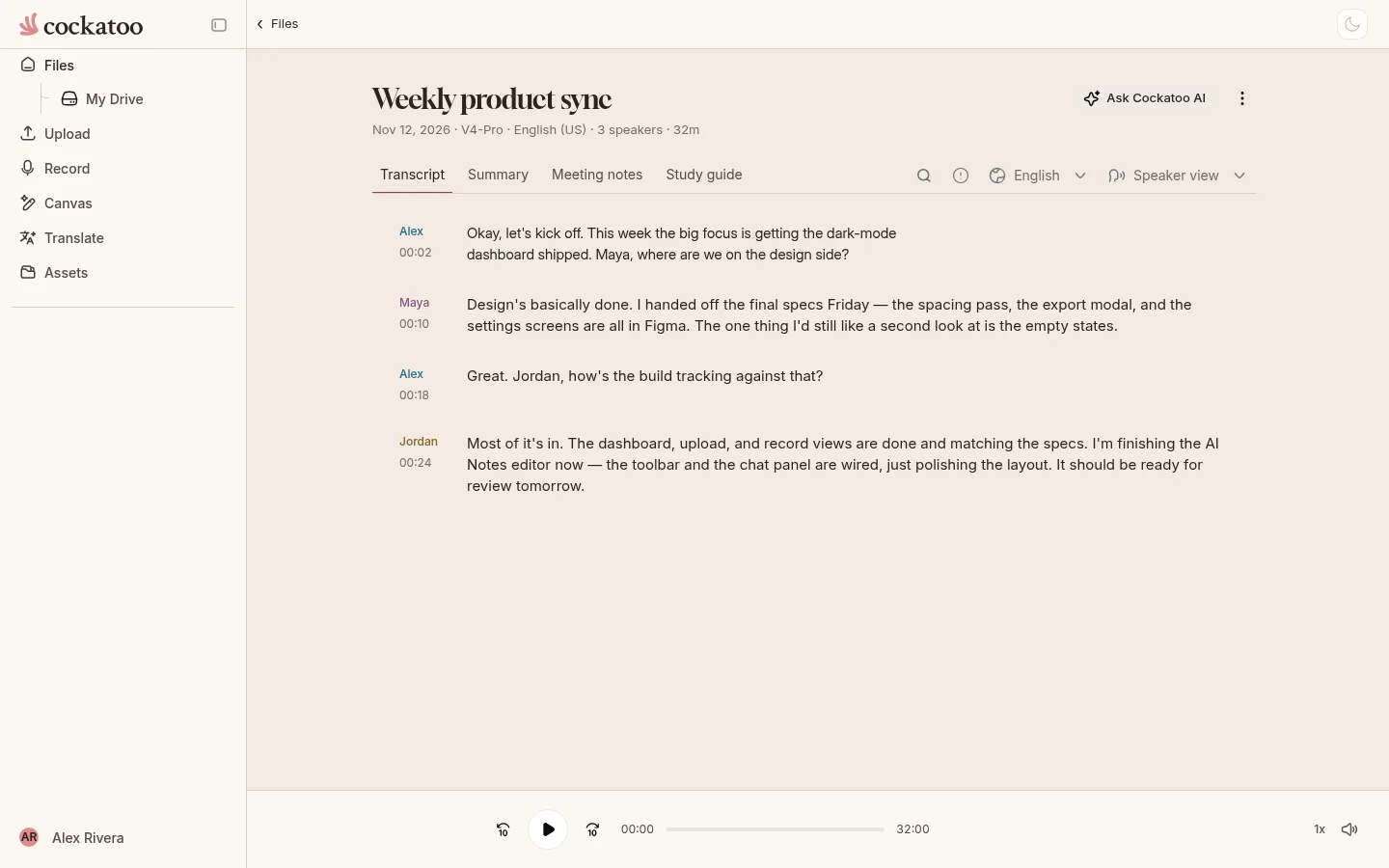
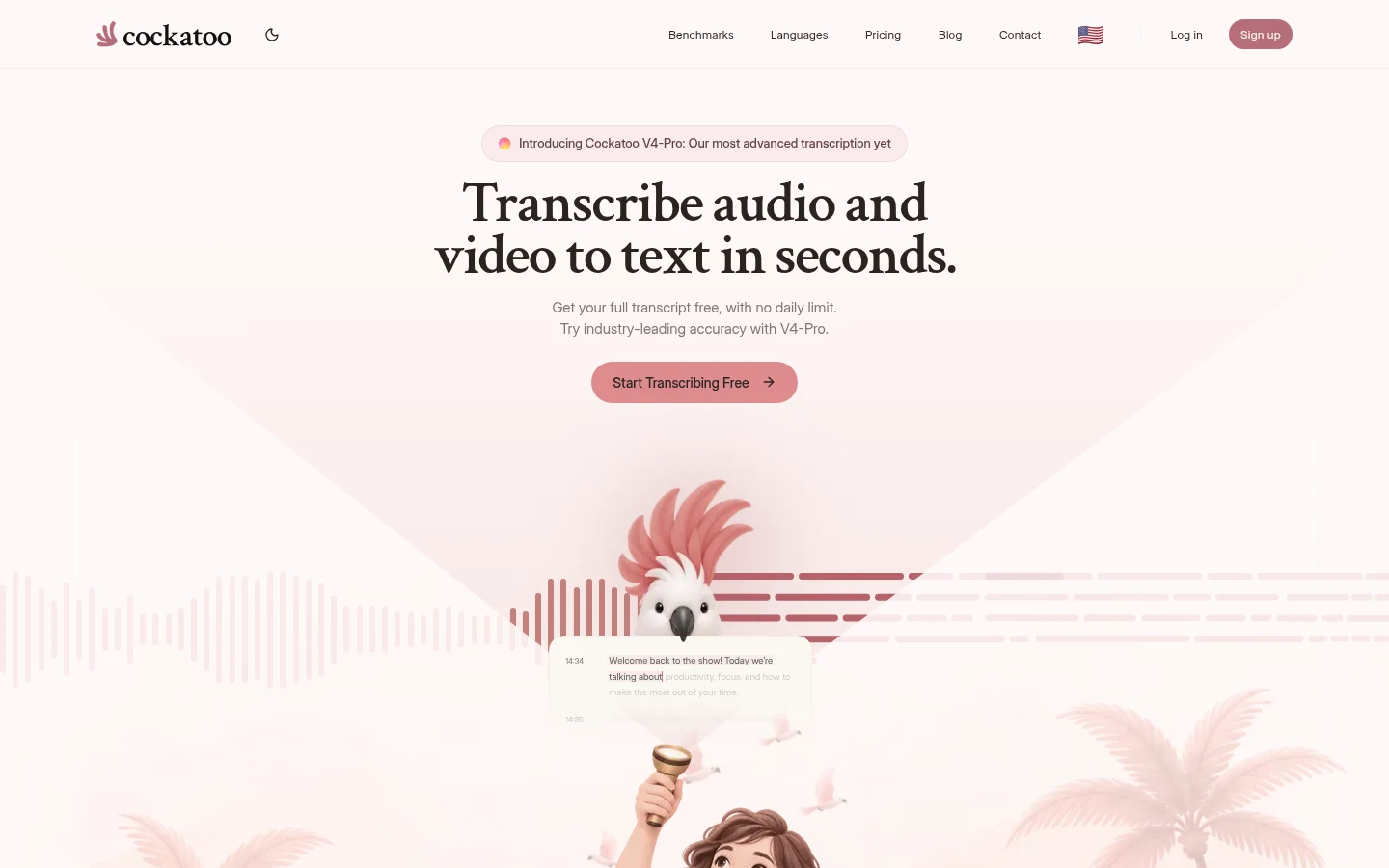
Cockatoo is a browser-based transcription tool for solo users and small teams who work from recordings: interviews, calls, lectures, podcasts and video. Its free plan gives you unlimited full-length transcripts in V4-Flash, with no daily limit and no credit card, which takes the per-hour and per-seat math out of high-volume work. Upload a file or paste a YouTube, Vimeo or SoundCloud link, edit the transcript in the browser, and export it as DOCX, PDF, TXT, SRT, VTT, CSV or JSON.
Speaker labels come with V4-Pro, the most accurate mode, which has the lowest error rate of the tested providers in 25 of 36 languages on FLEURS. The results are published, and accuracy varies by language and recording quality. Free accounts get weekly V4-Pro previews. Pro runs whole recordings in V4-Pro at about 20x real time, with priority processing and unlimited file length, and Max starts at $100 a month for large backlogs; current prices are on the pricing page. Team plans need at least 3 users. You can also record live in the web app's Record tab or in the iOS app, and Canvas turns any transcript into a summary, meeting notes or a study guide.
TurboScribe Is the Clearest Budget Pick for High-Volume Flat-Rate Transcription
For high-volume transcription at a predictable monthly cost, TurboScribe is the most straightforward budget option, offering unlimited transcription starting at $10/month when billed annually ($120/year); the monthly billing rate is $20/month, not $10/month, with no per-hour billing. TurboScribe claims 99.8% accuracy across its service but publishes no benchmark data to support that figure. A bare percentage with no per-language breakdown, no methodology, and no test corpus tells you nothing about performance on accented speech, non-English recordings, or two-hour interviews with overlapping voices.
Why Most Unlimited Plans Cap Out and How a Free Unlimited Mode Avoids That Ceiling
At scale, that becomes unsustainable, so the fine print quietly installs a ceiling, sometimes 720 hours per month, or throttles output above a threshold.
Cockatoo avoids that ceiling a different way: the fast mode is free. V4-Flash transcription has no daily limit on the free plan, so one more hour of audio never turns into a bill. What you pay for is V4-Pro, the most accurate mode, and its allowance is stated up front: Pro has higher usage limits, and Max gives 5x or 10x the Pro allowance.
Benchmarks Over Marketing - How to Verify Accuracy Claims Before You Commit
Cockatoo publishes per-language accuracy results across 36 languages using the FLEURS benchmark dataset, so you can check performance for your specific language before uploading a single file. Accuracy varies by language and recording quality, so test your own audio too.
Trint Alternative Pricing Compared So You Can Stop Guessing
Staring at a pricing page and trying to compare a $10/hour rate against a $25/month subscription is not an apples-to-apples exercise, because each model is built on a different unit of cost.

The Six Cost Models Behind the Price Tags
The real comparison is structural. Sonix charges per audio hour processed, so a busy week of interviews hits your card directly. Rev charges per minute on pay-as-you-go, but also offers a flat-minute subscription. Descript charges by usage tier with a monthly transcription cap. TurboScribe offers two tiers, a free plan (3 transcripts/day) and an Unlimited paid plan at $10/month (billed annually) or $20/month (billed monthly), and the paid plan's flat rate covers unlimited volume. Understanding those structural differences matters before any number on a pricing page makes sense.
A single high-volume week, ten hours of interview recordings, costs $100 on Sonix's $10/hour rate. That same volume costs roughly $50 on Rev's Essentials plan (which covers 5,000 minutes), $10/month on TurboScribe if billed annually ($20/month if billed monthly), and a fixed monthly rate on a flat-plan tool. The gap between those figures widens further once overages enter the picture.
Side-by-Side Pricing Tiers for the Main Alternatives
| Tool | Entry Paid Tier | Price | What's Included | Overage / Cap |
|---|---|---|---|---|
| Sonix | Core | $25/mo ($275/yr) | 5 transcription hours/mo | $10/extra hour |
| Rev | Essentials | $25.49/seat/mo (annual) | 5,000 AI minutes/mo | $0.25/min AI; $1.99/min human |
| Descript | Creator | $24/mo (annual) | 30 media hours/mo + 5hr bonus | Capped at tier |
| TurboScribe | Unlimited | $10/mo (annual) | Unlimited files, no hour cap | None stated |
| Otter.ai | Pro | $16.99/user/mo | 1,200 min/mo | Capped at tier |
| Trint | Starter | ~$80/seat/mo | 7-day trial, 3 files | Per-seat minimum |
| Cockatoo | Pro | See pricing | Whole recordings in V4-Pro; V4-Flash unlimited free | V4-Pro usage limits; Max from $100/mo |
Rev's Essentials plan, confirmed at $25.49/month billed annually, includes 5,000 AI minutes and layers in optional human transcription at $1.99 per minute for files where accuracy cannot be left to AI alone, making it one of the few plans that blends both modes under a single subscription.
Which Tools Let a Solo User Buy Without a Budget Approval
Trint's pricing structure is difficult to justify outside of specialist workflows; for general users who simply need to caption a video for publication or share transcripts internally, an ~$80/seat commitment is hard to absorb before a single file has been tested. That friction is exactly what sends most solo buyers searching in the first place. Rev, Sonix, Descript, TurboScribe, and Otter.ai all offer self-serve sign-up with no minimum seat purchase and no sales call required.
Cockatoo's Free plan is also fully self-serve, no credit card required, giving any solo user a no-risk entry point: unlimited full-length transcripts in V4-Flash, no daily limit, all export types, and weekly V4-Pro previews. When you need speaker labels or the most accurate mode on every file, Cockatoo Pro runs whole recordings in V4-Pro with priority processing and unlimited file length, so multi-hour recordings are supported without workarounds. Pro requires no minimum seat count; current prices are on the pricing page.
Among all the options in this comparison, Cockatoo's free plan sidesteps volume calculations entirely for V4-Flash: unlimited transcripts cost nothing, so you don't have to predict how much you will transcribe before you commit. Paid plans are for accuracy and speaker labels, and Max covers heavy V4-Pro use.
How to Get Started with a Trint Alternative Without Losing Your Files
Switching transcription tools carries real risk when your archived files, export formats, and downstream workflows are on the line. The safest approach is running both tools side by side for a week using your actual difficult content, not clean test audio, so you can verify accuracy, speaker labels, and export compatibility before moving anything. The sub-sections below walk through exactly how to structure that process and what to look for at each step.

The Four-File Test Protocol That De-Risks Any Switch
Running both tools simultaneously for one week at zero cost is the safest way to switch transcription software. Most serious alternatives offer a free tier that accepts real uploads, so you can confirm accuracy on your actual content before committing a dollar or moving a single archived file.
Upload four files representing your hardest real-world conditions, not clean studio recordings. Start with your most difficult: a 20-minute interview with a strong regional accent. Add a long recording (45-plus minutes), a file with two or more speakers talking over each other, and one piece of mixed-language content if relevant. Check speaker labels, timestamp alignment, and whether proper nouns land correctly. If the tool handles those four files, it will handle everything easier. Testing with dummy audio tells you nothing useful.
After each test file, export in every format your downstream workflow uses. Open the DOCX in Word and check whether headings, speaker labels, and paragraph breaks survived. Drop the SRT into your video editor and confirm timecodes sync. A transcript that looks clean inside a web app but arrives as unformatted text in Word is not editor-ready. Cockatoo's free plan includes all export types, DOCX, PDF, TXT, SRT, VTT, CSV and JSON, so format compatibility is verifiable before upgrading. For speaker labels, use a weekly V4-Pro preview on your multi-speaker test file.
A required sales call before you can upload a file is a product signal. It tells you the tool was built for a procurement team, not the one person who needs a transcript by Thursday. Industry research on free-trial design confirms that self-serve tools let users sign up and test without sales contact or organisational approval. If you hit a "request a demo" wall before your first upload, move on. The friction is the answer.
Next steps
If you have been paying Trint's per-seat minimum for a solo workflow, the path forward starts with matching your pricing model to your actual volume pattern, not your preferred brand name. Start with our transcription software.
The pricing architecture audit in the comparison section showed that seat minimums and hour caps are built into how most of these tools price, rather than a vendor quirk you can negotiate away. The flat-rate accuracy audit added a second layer: a genuinely unlimited plan only delivers its full value when it is backed by published per-language benchmarks rather than a bare percentage claim, because committing to a paid plan before confirming accuracy on your specific audio is the real switching risk. Together, those two findings point to one action: test a tool that publishes verifiable accuracy data and lets you upload a real file before entering a credit card number.
Start with transcription software with no seat minimum and a free plan that includes all export formats on the first upload. Upload your hardest file, the one with the accent or the crosstalk, export it to DOCX or SRT, and confirm it survives the format conversion before you move a single archived file from Trint.
Related Reading
Frequently Asked Questions
I only need to transcribe a few files a week, do I really need to pay for a full seat-based plan?
No. The post's core argument is that seat-based pricing like Trint's was designed for newsroom headcounts, not for one person with a recording and a deadline. Cockatoo's free plan has no daily limit, and its Pro plan is a self-serve individual plan with no minimum seat commitment, which is structurally different from tools built around team-first architectures.
Can I export my finished transcript into a format a colleague can open without creating an account?
Yes. Cockatoo exports finished transcripts as PDF and DOCX files, formats a collaborator can open, mark up, and return without ever creating an account. The post specifically calls this out as a workflow detail that matters more than marketing accuracy percentages.
My recordings are several hours long, will a free tier actually let me test whether a tool works for my audio?
On most tools, no. The post notes that free tiers across transcription tools typically cap uploads at 30 minutes per file, meaning a 90-minute interview simply does not fit inside a free-tier test. Cockatoo is an exception: its free plan transcribes full-length recordings in V4-Flash with no daily limit, and Pro supports unlimited file length.
How can I verify a transcription tool's accuracy for my specific language before committing to a paid plan?
Look for per-language benchmark data against a named dataset rather than a bare percentage claim. Cockatoo publishes per-language accuracy results across 36 languages on its FLEURS benchmarks page, so you can confirm coverage for your specific language before spending money.
Is Trint a good fit if I work in journalism or on an editorial team?
Trint was built for exactly that context. The post acknowledges its real strengths, inline editing, audio-synced playback, and team collaboration tools, fit a newsroom's review-and-publish workflow where a team of reporters shares transcripts, comments on them, and routes them for editorial review. The mismatch only appears for solo users or small teams who don't need shared editorial workflows.